
Colour & balayage · Mold and the villages
Colour, foils
and balayage.
Roots, full head colour, half and full head foils, hand-painted balayage, toners and glosses — mixed and applied in your own kitchen, rinsed out on site, across Mold and the villages. Published prices, published timings, and a straight answer about what is and is not included.
Prices
What it costs.
| Service | From |
|---|---|
| Root retouch Regrowth only · about 90 minutes | £38 |
| Full head colour Root to tip · about 105 minutes | £55 |
| Half head foils Top and sides · about 90 minutes | £60 |
| Full head foils Including underneath · about 135 minutes | £70 |
| Service | From |
|---|---|
| Balayage or ombré Hand-painted · about 150 minutes | £75 |
| Toner or gloss About 20 minutes | £21 |
| Conditioning treatment Added to a colour | £11 |
| Colour correction Charlotte sees the hair and tests a strand before she quotes, so it is never booked at a set price | Quoted in person |
Colour prices do not include the wash and blow-dry. The colour price covers the colour work — consultation, mixing, application, development, rinsing out and conditioning. Drying and styling afterwards is a separate service: a blow-dry from £22, or a cut and blow-dry from £35. Your hair is never left with colour in it. And every figure above is a starting price: length and thickness change it, the booking form works it out, and it is confirmed before you commit rather than at the door.
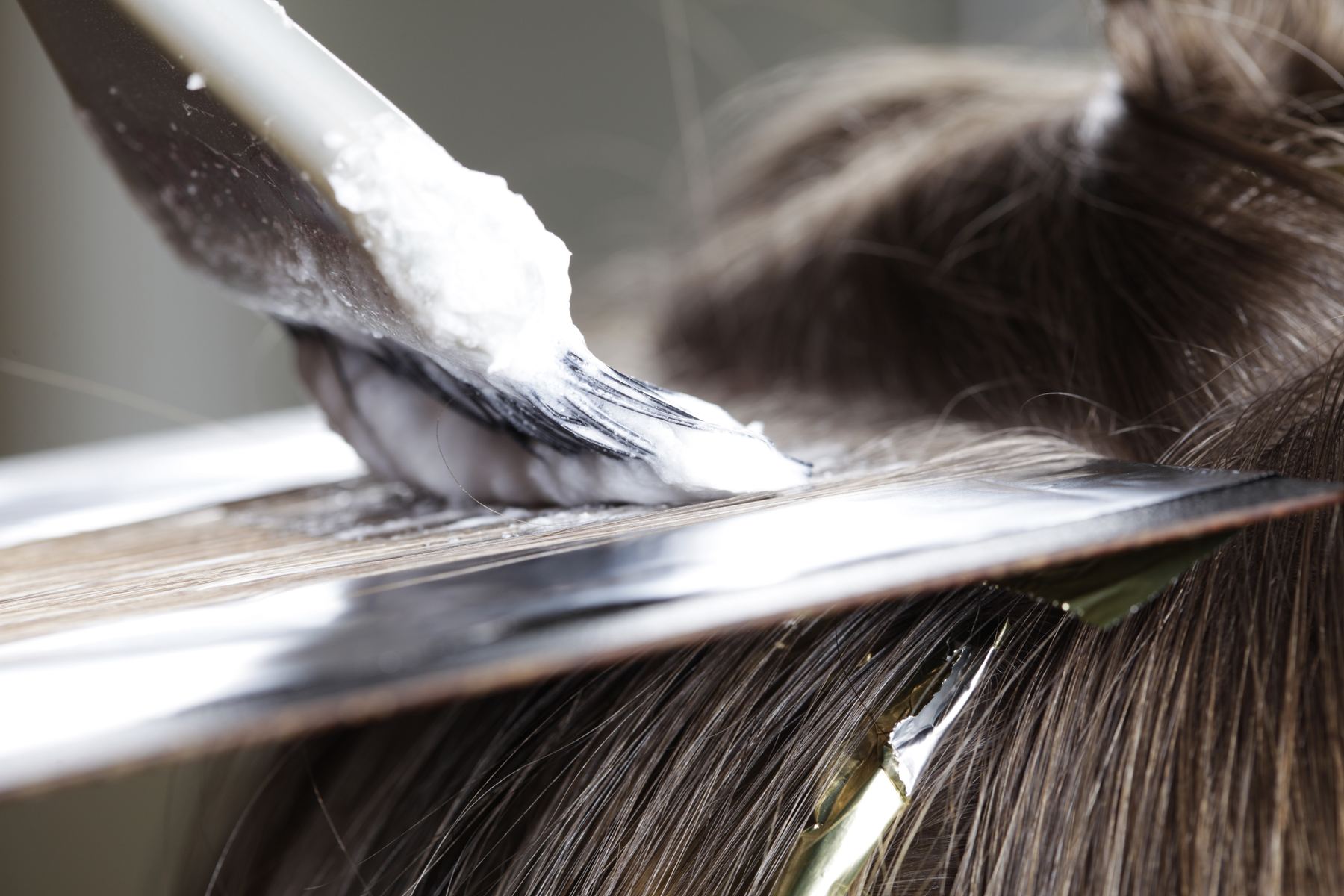
The menu, explained
What each one
actually involves.
Colour is the service people find hardest to compare, because most price lists give you a word and a number and leave you to guess. Here is what you are actually booking.
Root retouch
Regrowth only, matched to the colour already on your lengths. The two inches at the root are the only part that gets processed, which is the point — your ends are not put through it again.
It is the right service for most people most of the time, and it is the commonest quiet overcharge in this industry to sell a full head where roots would do. Four to six weeks is the honest interval. Some people, particularly brunettes with a lot of grey, will see regrowth at three, and it is better to say that than to pretend six weeks suits everybody.
One thing to know: permanent colour on grey leaves a line at the regrowth point. That is unavoidable, not a fault. If the four-to-six-week cycle does not fit your life, fine highlights woven through the greyest areas will blend rather than cover, and they grow out with nothing to see.
Full head colour
One colour, root to tip. The right choice when the lengths have faded or drifted, when the ends have gone tonally different from the base, when you are going darker or richer, or when a summer has lifted the mid-lengths unevenly.
Six to eight weeks between appointments, and it is common to alternate — a full head, then a root retouch, then a full head again — rather than processing the lengths every single time.
Half head foils
Foils through the top, crown, front and sides — everything you can see with your hair down. The underneath is left as it is.
The right choice if you wear your hair down. If you tie it up, a half head shows a darker layer underneath, and that is the whole of the half-versus-full decision. It is about how you wear your hair, not about budget.
Full head foils
Foils throughout — front, back, crown and underneath — for even brightness wherever the hair falls or is pinned.
Six to ten weeks. Foils start at the root, so there is a regrowth line at the parting, softer than a tint but present. That is the real reason people eventually migrate to balayage.
Balayage or ombré
Balayage is French for sweeping, and that is literally the technique: lightener painted on freehand through the mid-lengths and ends and left open to develop, so it graduates instead of striping. Ombré is the effect rather than the technique — a stronger, more defined graduation from a dark root to light ends. You can create an ombré using balayage.
The painting itself is quick. The appointment is long because of development and toning, not because of brushwork. On dark or previously coloured hair it often has to be worked inside foils instead of open, because dark hair will not lift far enough in the open air — same technique, more time.
Three to four months between appointments, and it grows out with no line at all, which is the whole appeal. But the tone on top of it lasts four to six weeks, and that is the fact nobody is ever told. Ask for a gloss at the halfway point rather than deciding your balayage has failed.
Toner or gloss
A toner refines the tone and knocks back unwanted warmth — the yellow and orange that lightening leaves behind. A gloss is more about shine and refreshing a colour that has gone flat. Twenty minutes, on top of a colour or entirely on its own.
It is charged separately because not everyone needs one and not every time. I will tell you at consultation whether your service will need it, so the number you are quoted is the number you pay.
Colour correction
Putting right a colour that has gone wrong: layered box dye, banding, uneven lift, a toner that has stacked up, an old henna, or a lightening job that went further than the hair could take.
There is no honest way to price this from a photograph. Four things decide what it costs — your colour history, the condition of the hair, how uneven it is, and how far it needs to move — and none of them can be read off a screen. Before anything is mixed there are real tests to do: an incompatibility test for metallic salts left by a home dye, which can react violently with professional product; an elasticity test to see whether the hair will survive being lifted; and a strand test to see what it actually does.
So Charlotte comes and looks at the hair, tests a strand, and gives you a firm price before anything is booked. Corrections frequently take more than one session, spaced out to keep the hair intact, and the honest version includes the possibility that the final colour is not the one in the photograph you brought. The booking form will not sell you this at an algorithmic price, and it is not supposed to.
How long it lasts
How each one grows out.
The single most useful table on this page. It is the difference between a colour that fits your life and one that does not.
| Service | Back in |
|---|---|
| Root retouch Hard line at the regrowth. Unavoidable | 4–6 wks |
| Full head colour Same line, softer if the shade is close to your own | 6–8 wks |
| Half or full head foils Softer line at the parting | 6–10 wks |
| Balayage or ombré No line at all — it simply softens | 3–4 mths |
| Toner or gloss Whatever else you have had | 4–6 wks |
The number people are never told is the last one. A balayage lasts three or four months. The tone sitting on top of it lasts four to six weeks. So somewhere around week six a lot of people decide their expensive colour has failed, when what has actually happened is that the toner has washed down and the warmth underneath has come back through. Hot water, hard water, chlorine, sun and heat styling all speed that up, and this is a hard-water part of the world.
A twenty-minute gloss puts it back without touching the lightening underneath. If you plan for it, blonde is much cheaper to keep than most people think. If you do not, it feels like a con.
Two honest alternatives worth knowing about: fine highlights woven densely through the greyest areas will blend grey rather than cover it, and grow out with nothing to see. And a demi-permanent colour fades out rather than banding, which suits anybody who cannot reliably get an appointment every five weeks.

Before any colour
The skin test.
Properly.
Before your first colour appointment Charlotte comes to you and does an allergy alert test — a dab of the actual colour below the crook of your elbow, left uncovered, and you tell her how it looked forty-eight hours later. It takes about five minutes and it is arranged when your booking is confirmed.
She will not post you one. Decanting colour out of the manufacturer’s packaging and putting it in the post is specifically not supported by UK industry guidance, and it may not be covered by insurance. It is one of the genuine costs of doing colour properly as a mobile hairdresser: two visits instead of one. It is also the reason to be wary of anyone who offers to save you the trouble.
Forty-eight hours is the minimum, not a target — some reactions take up to seventy-two hours to show — so if the diary allows it, we do it sooner.
- “But I have coloured my hair for years” — an allergy can develop at any point in life, even to a product used many times without a problem. Twenty years of colouring is twenty years of exposure, not proof of safety
- You need a new test if you are a new client, if it has been more than six months, if the brand or formula changes, or if you have had a tattoo since the last one
- It cannot be waived — not by a signature. Liability for personal injury cannot be signed away in a consumer contract, and skipping a manufacturer-required test can invalidate insurance
- “PPD-free” is not “allergy-free” — PTD, the usual alternative, is chemically related and someone allergic to one can react to the other
- A negative test is a screen, not a guarantee. It substantially reduces the risk. It does not remove it, and anybody telling you otherwise is overselling
- Tell her about black henna tattoos — they carry very high levels of PPD and are a known risk factor. It is on the questionnaire for a reason
On the day
What actually
happens.
The skin test, first
At least forty-eight hours ahead, in person, five minutes at your door. A dab of the actual colour below the crook of your elbow, left uncovered, and you tell me how it looked two days later. Not posted, not skipped, not signed away.
Consultation on the day
What is already on the hair, what has been on it before, what you want, and what your hair will realistically do. This is where the price is confirmed — before anything is mixed, not after.
Set up and protect
Floor covering down, shoulders covered, barrier cream round the hairline and ears. A window open. Colour mixed fresh in your kitchen, not carried round pre-mixed in a bottle.
Applied and developed
Sectioned and applied properly — roots first where the grey is most stubborn, because it needs the longest. Then the development time, which is the development time. Rushing it is how colour goes patchy.
Rinsed out on site
Warm water, thorough rinse, conditioner, at the portable basin. Nobody is bent over a kitchen sink and nobody goes upstairs. This is where the colour service ends.
Finished, if you want it finished
A blow-dry from £22 or a cut and blow-dry from £35, booked at the same time. Or towel-dried and left to you — plenty of people prefer that, and you should not have to pay for it either way.
Before I arrive
What I need
at your house.
Less than people expect. Colour needs a little more than a haircut — a surface for bowls and foils, and light you can actually judge tone by — but nothing you have to go out and buy.
One thing worth knowing: do not wash your hair to be helpful. For most colour going on at the scalp, day-old dry hair is better, because the natural oils are protective. I will tell you at booking if yours is one of the exceptions.
- A hard-floor room if you have one — kitchen or utility is ideal. If it is carpet, say so when you book and I will bring more covering
- A chair without arms, and a table or worktop for bowls, brushes, foils and clips
- Good light — daylight if possible. Tone cannot be judged honestly under a warm bulb, and this matters far more for colour than for cutting
- A plug socket and an ordinary tap. The wash station carries its own water but has to be filled and emptied
- A window that opens. Not a rule, just better — colour and lightener should not be mixed in a sealed room
- Something old on, or a dark top under the gown, and pets and small children somewhere else
I bring the rest: towels, floor covering, wash station, water, barrier cream, products, and every scrap of waste goes home with me.
Where I come to
Mold and thirty-five villages.
Colour travels to all of it, with no mileage charge anywhere: Mold, Sychdyn, Gwernymynydd, Nercwys, Mynydd Isa, New Brighton, Bryn-y-Baal, Alltami, Gwernaffield, Pantymwyn, Cilcain, Rhydymwyn, Nannerch, Caerwys, Afonwen, Rhosesmor, Rhes-y-cae, Wern y Gaer, Halkyn, Pentre Halkyn, Brynford, Northop, Northop Hall, Buckley, Drury, Padeswood, Coed-talon, Pontblyddyn, Treuddyn, Cadole, Loggerheads, Maeshafn, Llanferres, Eryrys and Llanarmon-yn-Iâl.
The rest of the menu
Also on the price list.
Cuts & styling
Cut and blow-dry, restyles, blow-dries, gents, children and hair up.
Cuts & styling → PermsPerms & treatments
The modern perm, and an honest account of what a treatment can do.
Perms & treatments → WeddingsBridal & events
Wedding mornings, trials, the bridal party, races, proms and hair up.
Bridal & events →Questions
Asked and
answered.
Does the colour price include a blow-dry?
No. The colour price covers the colour work — the consultation, the mixing, the application, the development time, rinsing out and conditioning. It does not cover the blow-dry finish. That is a separate service: a blow-dry from £22, or a cut and blow-dry from £35. Your hair is never left with colour in it.
Why is the blow-dry not just included?
Because not everyone wants one, and building it into every price would mean charging people for a finish they would rather do themselves. Most salons in the UK doing serious technical work price colour and finish separately for exactly that reason. It also means you can compare our £75 balayage with somebody's £120 balayage and know what is actually in each number.
Do I need a skin test if I have been colouring my hair for years?
Yes. An allergy can develop at any point in life, even to a product you have used many times without a problem — that is how sensitisation to hair dye works, and twenty years of colouring is twenty years of exposure rather than proof you are safe. A test is needed for every new client, and again if it has been more than six months, if the brand or formula changes, or if you have had a tattoo since the last one.
How far before the appointment does the skin test have to be?
At least forty-eight hours, because a reaction can take that long to show. I would rather have longer than the minimum — some reactions take up to seventy-two hours to appear — so if the diary allows it we do it earlier.
Can you post me a skin test?
No, and you should be wary of anyone who offers to. Decanting colour out of the manufacturer's packaging and posting it to a client is specifically not supported by UK industry guidance, and it may not be covered by insurance. I come and do it in person. It takes about five minutes and I arrange it when I confirm your booking.
What happens if I skip the skin test?
I cannot colour your hair. It is not a formality I am able to waive, however well we know each other — a signed disclaimer would not protect either of us, because liability for personal injury cannot be signed away in a consumer contract, and skipping a manufacturer-required test can invalidate insurance.
What is actually in hair colour that people react to?
Usually PPD, para-phenylenediamine, which is the main colour precursor in permanent dye, or PTD, which is chemically related to it. Someone allergic to one can react to the other, so a product described as PPD-free is not the same thing as risk-free.
Root retouch or full head colour — which do I need?
A root retouch if the lengths are still the colour you want and only the regrowth has come through. That is most people, most of the time, and it is kinder to your ends because they are not being processed again. A full head if the lengths have faded or gone uneven, or you are changing shade. I will tell you honestly which one you need — there is no reason to pay for a full head if roots will do.
Half head or full head foils?
It depends on how you wear your hair, not on your budget. A half head covers the top, crown, front and sides — everything you see with your hair down — and leaves the underneath natural. If you tie your hair up, a half head shows a darker layer underneath, and that is when a full head is worth the extra £10. If it always stays down, a full head is money spent on hair nobody sees.
What is the difference between balayage and highlights?
Highlights are woven into foils and start at the root, so they grow out with a line at the parting. Balayage is painted on freehand through the mid-lengths and ends and left open to develop, so there is no root line and it grows out softly. Highlights give brightness and evenness. Balayage gives a graduated, lived-in finish and a much longer gap between appointments.
Balayage or ombré — what is the difference?
Balayage is the technique — sweeping the lightener on by hand. Ombré is the effect — a graduation from a darker root down to lighter ends, with more visible contrast than balayage. You can create an ombré using balayage, so they are not really rivals.
Can I have balayage on dark hair?
Usually yes, but it may need to be worked inside foils rather than painted open, because dark or previously coloured hair often will not lift far enough in the open air. Foils hold the heat and keep the product moist, which gives more lift. It is the same technique, it just costs more time.
How often will I need to come back?
Roots every four to six weeks. Foils every six to ten weeks. Balayage every three to four months. And a toner every four to six weeks whatever else you have had — that is the one nobody expects, and it is why blondes feel their expensive colour has gone brassy.
Why is the toner charged separately?
Because not every colour needs one, and not every time. It is a separate product, a separate step and about twenty more minutes. I will tell you at consultation whether yours will need one, so the price does not move on the day.
My blonde has gone brassy. Has the colour failed?
No. The lightening underneath is permanent; the tone sitting on top of it is not. Toner washes down over about four to six weeks, and hot water, hard water, chlorine, sun and heat styling all speed it up. A gloss brings it back without re-lightening the hair.
Can I go from dark to blonde in one appointment?
Usually not, and anybody who promises it has not seen your hair. It is typically one or two shades a session, spaced six to eight weeks apart, and how far it can go depends on what colour is already on there, how coarse your hair is and what condition it is in. Rushing it is how hair breaks.
Why will you not quote for a colour correction over the phone?
Because the price depends on things I cannot see in a photograph — how many layers of colour are on there, whether it is banded, what condition the hair is in and how far it needs to move. Corrections often take more than one session. Any number I gave you without seeing the hair would be a guess, so it is from £50 and quoted in person, and it is never bookable online.
How does washing colour out work in my house?
The van carries a portable inclinable wash station with its own water tanks, so your colour is rinsed properly, on site, with warm water and conditioner. Nobody is bent over a kitchen sink and nobody goes upstairs. It also means the rinse is included in the colour price — it is the drying and styling afterwards that is separate.
Will you make a mess of my kitchen?
No. Floor protection goes down before anything is mixed, your shoulders are covered, and barrier cream goes round the hairline and ears. Everything I bring in leaves with me, including the waste. If your kitchen is carpeted or tight on space, tell me when you book and we will pick a different room.
How long will you be at my house?
Roots about ninety minutes, a full head colour about an hour and three-quarters, half head foils about ninety minutes, full head foils about two and a quarter hours, balayage about two and a half. A toner is twenty minutes on top. Add a blow-dry or a cut and blow-dry if you want it finished, and allow a few minutes each end for setting up and packing away.
Colour, without
the guesswork.
Pick your service, answer a few questions about your hair, and the form quotes you exactly before you confirm. The skin test is arranged with your booking.