
Perms & treatments · Mold and the villages
The perm,
grown up.
Soft movement rather than tight curl, done at your own kitchen table — plus a conditioning treatment with an honest account of what it can and cannot do. Two services almost nobody around here still offers, and two of the easiest to be sold badly.
Prices
What it costs.
| Service | From |
|---|---|
| Modern perm Soft movement, not tight curl · about 150 minutes | £50 |
| Conditioning treatment Added to a cut or a colour · 15 minutes | £11 |
| Conditioning treatment Booked on its own · about 30 minutes | £24 |
Booked together with a cut and blow-dry, a conditioning treatment and a finish is one of the three standard combinations — one visit, one setup, one card payment.
The perm price does not include the wash and blow-dry. Like the colour services, it covers the perm itself — consultation, tests, winding, processing, neutralising and rinsing. Drying and styling afterwards is separate: a blow-dry from £22, or a cut and blow-dry from £35.
Every figure is a starting price. Length and thickness change it, the booking form works it out, and it is confirmed before you commit rather than at the door. No travel charge anywhere on the round.
The honest market position
Hardly anybody
still does these.
When we priced this market properly — around forty-five salons across Flintshire, Denbighshire, Wrexham and Conwy that publish a price list — four of them published a perm price. Not four in ten. Four.
That is not because people stopped asking. It is because a perm is two and a half hours of a stylist’s day, and a chair-rent salon measures everything in pounds per hour. A generation of stylists came through training barely doing any. The stock came off the shelf, and then the service came off the menu.
So “who still does perms near me” is a real search made by real people who have already rung round and been told no. If that is you, the answer here is yes.
Who books one
- Longstanding clients, often seventy-plus — body and volume in hair that has gone fine, and a habit kept up for decades. Sitting through two and a half hours in your own armchair rather than a salon chair is not a small thing at that age
- Women in their forties to sixties who want lift, not curl — volume at the root so hair stops collapsing flat and a blow-dry lasts
- Younger clients, quite often men — texture and volume on top with the sides kept short. It is the fastest-growing group nationally
Three different people wanting three different things from the same chemistry. Which is exactly why the consultation decides the rod size before anything else happens.
The menu, explained
What each one
actually involves.
Modern perm
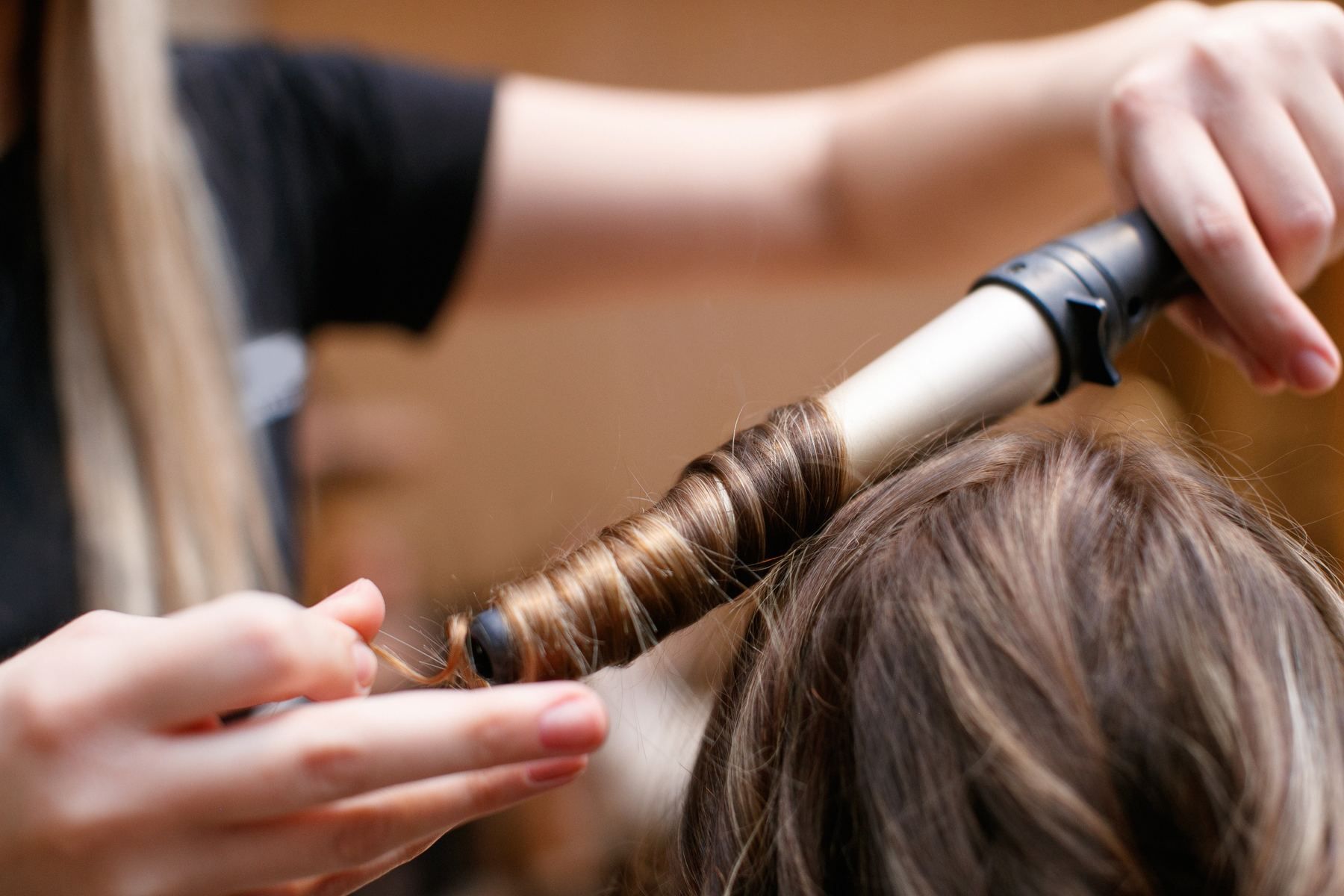
A body wave rather than a curl. Larger rods, mixed sizes across the head, placed irregularly rather than in a grid, and processed to a soft result instead of all the way to maximum curl. What you get is hair that holds a blow-dry, air-dries with shape in it and has visible movement — not ringlets.
It works in two chemical steps. A reducing lotion breaks a proportion of the bonds that hold your hair in its current shape; the hair is wound on rods; then a neutraliser re-forms those bonds around the new shape. The second step is the one that matters. Under-neutralised hair keeps on softening, and that is how perms go wrong. It is also why this is a two-and-a-half-hour appointment and not something to squeeze in.
The strength of lotion is matched to your hair rather than being one bottle for everybody, and the technique on fine or previously coloured hair is different from the technique on coarse virgin hair. That, plus the rod size, is the whole difference between a 1985 perm and a 2026 one.
What a perm cannot do
It cannot be reversed. Not by a treatment and not by another perm. You grow it out or you cut it out. That is the honest headline and everything else follows from it.
It cannot make hair thicker — it makes hair look fuller by lifting it off the head. It cannot give the crisp, defined curl of a tong; a cold perm looks curliest when wet and looser when dry. It cannot go on bleached hair. It cannot rescue hair that is already breaking — it will accelerate it. And on unevenly porous hair, such as a head of old highlights, the result cannot be guaranteed to be even.
Which is why there is a strand test before anything is wound, and why the answer is sometimes no.
Conditioning treatment
Fifteen minutes alongside a cut or a colour, or half an hour as a visit in its own right. It coats the hair and smooths the cuticle so it lies flat, which is why the hair comes out softer, shinier, far easier to comb and noticeably better to blow-dry.
The difference between the add-on and the standalone is thoroughness, not strength. On its own it gets a proper detangle first, a sectioned application so the product genuinely reaches everywhere rather than being smoothed over the outside, time to sit, and a thorough rinse. It is a better-executed version of the same thing, not a different chemical.
It is worth having if your hair is bleached, highlighted, coarse, dry, long enough that the ends are years old, heat-styled daily, or simply behaving like straw. It is not worth having on fine limp hair that is easily weighed down, on healthy hair that has never been coloured, or on short hair that gets cut every five weeks. Charlotte will say so rather than adding eleven pounds to the bill.

A perm, start to finish
What actually
happens.
Two and a half hours, in your own house, with your own tea. For the client who finds a salon morning tiring, that is the strongest argument for doing it this way.
Consultation and tests
Before anything is mixed: what has been on the hair, an elasticity test to see whether it can take the process, a porosity check, and a test curl to settle the lotion strength and the rod size. If the answer is no, you find out now and it costs you nothing.
Set up, and open a window
Floor covering down, shoulders protected, kit laid out. The room wants to be airy rather than sealed — perm lotion has a strong smell and a domestic kitchen does not clear it the way a salon does.
Wound on rods
Sectioned and wound, rod size chosen for the result rather than out of habit, and often more than one size across the same head. This is the slow part and it is the part that decides what the perm looks like.
Processed and checked
Lotion on, then development — with a rod unwound part-way through to see how the curl is actually forming rather than trusting the clock.
Rinsed and neutralised
Thoroughly rinsed at the portable basin, then the neutraliser, then rinsed again. This is the step that locks the shape in, and it is the one that is never hurried.
Then leave it alone for forty-eight hours
No washing, no wetting, no bobbles, no clips, no hard brushing, and stay out of steamy bathrooms. It is the one bit of aftercare that genuinely changes what you are left with.
The bit the industry gets wrong
Nothing repairs hair.
Hair above the scalp is dead. It has no blood supply, no cells doing repairs and no capacity to heal itself. Nothing you put on it changes that, and the UK advertising regulator has said plainly that it has not seen evidence a conditioner can repair damage. Every “repairs your hair from the inside out” on every bottle in the country is doing a lot of work that the evidence does not support.
That is not a reason to skip a treatment. It is a reason to know what you are buying. A good conditioning treatment makes hair genuinely softer, shinier, easier to comb and much better to blow-dry, and it reduces the breakage that comes from dragging a brush through hair that will not co-operate. Those are real, you will feel them, and they last a few washes.
What it is not doing is fixing anything. Split ends are cut off, not mended. Bleach damage is grown out, not undone. Anybody who tells you otherwise is selling.
Straight answers
- What a treatment does — smooths the cuticle so it lies flat and reflects light; adds slip so combing stops tearing; makes the blow-dry easier and the finish better; lasts a handful of washes
- What a bond builder does — used during bleaching, it measurably reduces breakage and improves how the hair holds up. That much is real and tested
- What neither does — restore hair to an earlier state, rebuild what bleach destroyed, or make damage go away. The word for that is “grow out”
- Protein is not the answer to everything — too much of it makes hair stiff and brittle. It is a different problem from dryness, and treating one as the other makes things worse
- The most useful thing on this page — sometimes the answer is that your hair does not need a treatment, and being told that is worth more than eleven pounds
Where I come to
Mold and thirty-five villages.
Perms and treatments travel to all of it, with no mileage charge anywhere: Mold, Sychdyn, Gwernymynydd, Nercwys, Mynydd Isa, New Brighton, Bryn-y-Baal, Alltami, Gwernaffield, Pantymwyn, Cilcain, Rhydymwyn, Nannerch, Caerwys, Afonwen, Rhosesmor, Rhes-y-cae, Wern y Gaer, Halkyn, Pentre Halkyn, Brynford, Northop, Northop Hall, Buckley, Drury, Padeswood, Coed-talon, Pontblyddyn, Treuddyn, Cadole, Loggerheads, Maeshafn, Llanferres, Eryrys and Llanarmon-yn-Iâl.
The rest of the menu
Also on the price list.
Cuts & styling
Cut and blow-dry, restyles, blow-dries, gents, children and hair up.
Cuts & styling → ColourColour & balayage
Roots, full head colour, foils, hand-painted balayage, toners and correction.
Colour & balayage → WeddingsBridal & events
Wedding mornings, trials, the bridal party, races, proms and hair up.
Bridal & events →Questions
Asked and
answered.
Does anybody still do perms around Mold?
Almost nobody, which is why people end up searching for it. When we priced the market across Flintshire, Denbighshire, Wrexham and Conwy, around forty-five salons published a price list and four of them published a perm price. It has quietly fallen off menus — not because clients stopped wanting it, but because it takes two and a half hours of a stylist's day and a lot of salons stopped stocking for it.
Will I look like my mum did in 1985?
No, and that look was not inevitable even then. Eighties perms used small rods, laid out in a rigid uniform grid, with one strength of lotion for everybody, processed all the way to maximum curl. Larger rods, mixed sizes on the same head, irregular placement and a shorter process give movement and volume instead. It is the same chemistry and a completely different result.
What does "soft movement rather than tight curl" actually mean?
A body wave. Hair that holds a blow-dry instead of hanging flat, that air-dries with some shape in it, and that has visible waves rather than ringlets. On straight hair it is roughly the effect of a loose tong — except it survives washing.
Will a perm damage my hair?
It is a chemical process that permanently alters the hair's internal structure, so it genuinely changes the hair. On healthy, uncoloured or lightly tinted hair, at the right strength, the effect on condition is modest and manageable. On bleached or already fragile hair the honest answer is no, and Charlotte will not do it.
Can you perm coloured hair?
Usually yes if it is tinted, subject to a strand test on the day. If it is highlighted it depends how much — the traditional guideline is not above about a third lightened, and results can be uneven because porosity varies across the head. If it is bleached, no.
Can I have a perm and my colour done on the same day?
Not as a routine. UK professional guidance is a minimum of two weeks after colouring before perming — ideally three or four — and ten to fifteen days after perming before colouring. If you want both, the perm goes first, partly because perming lightens the colour that is already on the hair. That means two appointments a fortnight apart, and it is worth knowing before you book.
Do I need a skin test for a perm?
A perm does not need the forty-eight-hour allergy alert test that hair colour does — that test exists for the dye chemistry, not for perm lotion. What a perm needs is a consultation and tests on the day: elasticity, to see whether your hair can take the process; porosity, because uneven porosity gives uneven curl; and a test curl to get the strength and rod size right. If you are having colour as well, that does need the forty-eight-hour test.
Why can I not wash my hair for forty-eight hours?
The hair is still settling into its new shape after the neutralising step. Washing it, wetting it, tying it up, clipping it or brushing it hard inside that window can drop or distort the wave. Manufacturers and salons are consistent on forty-eight hours, and it is the one piece of aftercare that genuinely changes the result you are left with.
How long does a perm last?
A standard perm is roughly three to six months. A soft body wave — which is what this is — is nearer two to three, because looser waves relax faster. That is the trade-off for softness, and it is better said now than discovered in month three.
What happens when it grows out? Will I get a line like with colour?
No, and this is the perm's best feature. There is no demarcation line anywhere. The wave gradually softens and new growth comes through straight at the root. If you decide not to have it done again, nothing goes wrong — it simply fades out over a few months.
How long does it take, and is my hair long enough?
Allow about two and a half hours. It is not a service that can be rushed — the processing time is the processing time, and hurrying the neutralising is how perms go wrong. On length: the hair has to wrap round a rod at least once, so roughly three inches is the absolute minimum and four or five gives the softer, looser result most people are actually after.
Does the perm price include a blow-dry?
No. Like the colour services, the perm price covers the perm itself and not the wash and blow-dry finish afterwards. A blow-dry is £22 and a cut and blow-dry £35, booked at the same time if you want it.
Will it make my hair look thicker?
It will make it look fuller, by lifting it away from the head and giving it shape and volume. It does not add strands and it does not make individual hairs thicker. Nothing does.
Does the perm smell?
Yes, during. Perm lotion has a distinctive sulphurous smell, and in a salon it disappears into a big ventilated room — in a domestic kitchen it does not. Expect a smell while it is on and some residual smell for a day or so afterwards. Open a window, and do not book it for the morning of a dinner party. Modern lotions are better fragranced than they were, but they do not smell of nothing.
Do conditioning treatments actually work, or is it an upsell?
They work in a specific and limited way, and it is worth being precise about it. A conditioning treatment coats the hair and smooths the cuticle so it lies flat, which makes hair softer, shinier, far easier to comb and noticeably better to blow-dry. You will feel the difference. It sits on the hair rather than inside it, and it lasts a few washes rather than forever.
Can a treatment repair my hair?
No — and be careful of anybody who says otherwise. Hair above the scalp is dead keratin with no ability to heal itself, and the UK advertising regulator has been explicit that it has not seen evidence a conditioner can repair damage. What a good treatment genuinely does is make hair behave better, feel stronger, comb more easily and break less. That is worth having. It is not repair.
Is a bond-building treatment — Olaplex and the like — worth it?
For hair that is bleached or heavily processed, yes: the measured benefits are real — less breakage, easier combing, better tensile strength during and after a chemical service. What the evidence does not support is the marketing story about rebuilding bonds deep inside the hair and restoring it. If your hair is in good condition you are paying for something you do not need. What is offered here is a conditioning treatment, which is a different and more modest job — and Charlotte will tell you which conversation you are actually in.
Fifteen minutes or thirty — what is the difference?
Not a stronger chemical. A more thorough one. Fifteen minutes as an add-on does a real job: hair comes out softer and blow-dries better, and it lasts a few washes. The standalone version buys a proper detangle first, sectioned application so the product actually reaches everywhere rather than being smoothed over the outside, time to sit, and a thorough rinse. Better executed, not twice as powerful.
How often should I have a treatment?
If your hair is bleached or heavily processed, roughly every four to six weeks alongside your other appointments. If it is in decent condition, when it starts feeling rough — which for a lot of people is twice a year. It is not something you need every visit.
Who does not need one?
Fine, limp hair that is easily weighed down — a treatment can make that worse, not better. Healthy hair that has never been coloured. Anyone already using a decent conditioner properly at home. And short hair that is cut every five or six weeks, because the damaged part keeps being removed anyway. Charlotte will say so rather than adding £11 to the bill.
Two and a half hours,
in your own chair.
Pick the service, answer a few questions about your hair, and the form quotes you exactly before you confirm.