
Cuts & styling · Mold and the villages
Cuts and styling.
At your kitchen table.
A ladies’ cut and blow-dry, the gents’ cut, the children’s trim, the blow-dry before a night out and the hair up before a wedding — all of it done in your own home, in Mold and the villages around it. Every price and every timing is published below, which is more than most salons around here will tell you before you ring.
Prices
What it costs.
| Service | From |
|---|---|
| Cut and blow-dry About 55 minutes | £35 |
| Restyle About 70 minutes | £45 |
| Blow-dry About 35 minutes | £22 |
| Curly blow-dry About 50 minutes | £27 |
| Service | From |
|---|---|
| Gents cut About 30 minutes | £18 |
| Faded gents cut About 45 minutes | £21 |
| Children’s cut Under twelve · about 25 minutes | £12 |
| Hair up and occasion styling About 75 minutes | £60 |
Every price here is a “from” price. What you actually pay depends on how long and how thick your hair is — the booking form asks, works it out and shows you the figure before you confirm. That figure does not change at the door, and there is no travel charge anywhere on the round. Want a treatment alongside? A conditioning treatment is £11 added to any of these — see perms and treatments.
The menu, explained
What each one
actually involves.
Most price lists give you a word and a number. Here is what you are actually booking, how long it really takes, and what makes it take longer.
Cut and blow-dry
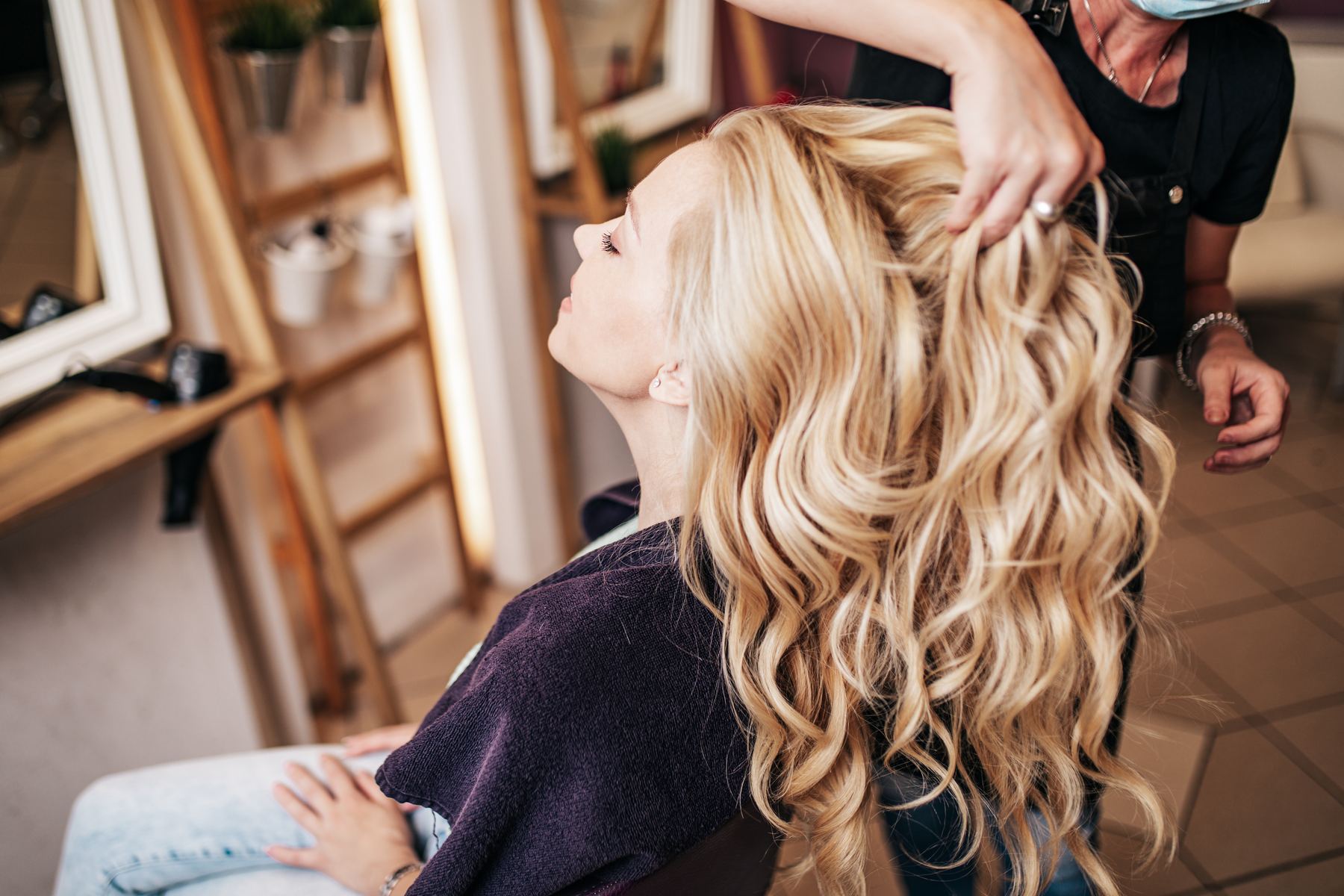
The standard appointment, and the one most people book. A consultation first — longer if we have not met — then washed and conditioned, cut wet in sections and cross-checked, rough-dried to about eighty per cent, then blow-dried section by section on a round brush with proper tension and finished with a cool shot so it holds.
Fifty-five minutes is the honest figure for short to mid-length hair, and it is bang on the national average for a salon appointment. What pushes it past that is density and length rather than the cut itself — thick, long hair can add fifteen or twenty minutes on the drying alone. Blunt one-length lines take longer too, because there is nowhere for an error to hide.
Restyle
A restyle is not a longer haircut. It is a different conversation. Before anything is cut we talk about face shape, how thick and how coarse your hair actually is, and — the part people forget — where it grows. A cowlick, a double crown or a whorl at the nape will each quietly veto certain shapes, and it is better to know that before the length has gone.
We also talk about how much time you will genuinely give it in the morning. A shape that needs twenty minutes and a round brush every day is the wrong shape for someone who has four minutes. The cut itself usually changes the internal structure rather than just the outline, so there is more sectioning, more cross-checking, and very often a second pass after the blow-dry, because a new shape only shows its real fall once it is dry.
The honest caveat: some changes should not be done in one visit. Taking a lot of length off curly or coarse hair, or cutting a shape that fights the way the hair grows, is better done in stages. I will say so if that is what I think.
Blow-dry
Wash, condition, heat protectant, rough-dry, then section by section on the round brush. Smooth, with volume, or with movement — whichever you want on the day.
It lasts two to three days for most people. Thirty-five minutes is right for short to mid-length; long or thick hair genuinely needs forty-five to sixty, and I would rather book the time than rush the ends.
Curly blow-dry
A blow-dry finished with curl. Dried smooth first, then set with the round brush and tongs and dressed out, so it has bounce and movement and holds through an evening rather than dropping by nine o'clock. Your own hair does not need to be curly for this — most people who book it have straight hair.
It is longer than a standard blow-dry because there is a whole setting stage after the drying. It is a finish, not a cutting method — it does not change your cut, and it washes out.
Gents cut
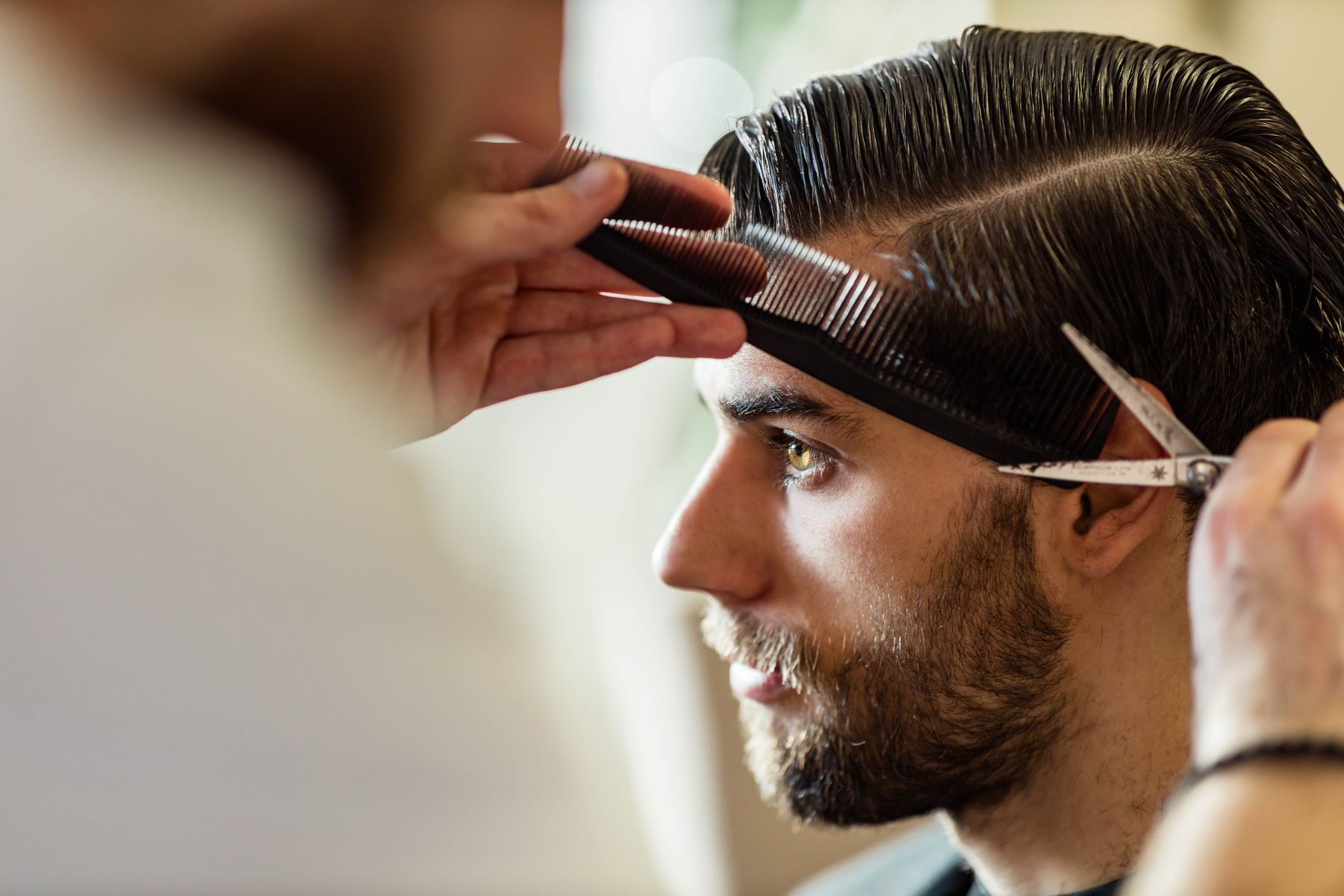
Clipper or scissor cut, whichever the shape needs. Scissor-over-comb or clipper-over-comb through the sides and back, scissor work on top, then the neckline and around the ears detailed properly, and a quick dry finish.
A gents cut is about shape and length. Four to six weeks between appointments for a scissor cut. What makes it run longer is heavy density, or longer men's hair that needs real layering rather than clipper work.
Faded gents cut
A fade is not about length, it is about blend — a controlled gradient with no line in it anywhere. That is what the extra fifteen minutes buys. It is built in several passes through different guard lengths and lever positions, then checked from three or four angles in good light, because a fade that looks perfect from the front can have a step in it from the side.
A skin fade runs all the way down to bare skin, finished with a razor or foil shaver to take out the clipper shadow. A fade kept off the skin is blended through the guard lengths instead — softer, and considerably more forgiving as it grows. Same price; the difference is how often you want to be re-cut. A skin fade wants freshening every two to three weeks because the shaved skin grows in first and the gradient blurs into general shortness. Off the skin will hold four to five.
Children’s cut
At home, which is usually easier on everybody. No waiting room, no strange chair, no queue of adults watching. If your child finds haircuts genuinely difficult — the noise, the bright lights, being touched, or simply someone coming at their head with scissors — say so when you book.
There is a lot that can be adjusted. Scissors instead of clippers, so there is no noise and no vibration. A tablet or the television left on. Sitting where they can see what is happening rather than being turned away from it. And no rush: it is better to take two goes at it than to force one.
Book it alongside an adult appointment and it is one visit, several chairs and one card payment at the end.
Hair up and occasion styling
Hair up for an evening out, a christening, a party, a race day or a big birthday. Buns, chignons, French pleats, half-up styles, plaited and braided work, and soft or Hollywood waves. Fascinators and hats need a style built to take a comb or a grip at a particular angle, which is worth mentioning when you book rather than producing on the day.
Bring a photo of what you want and tell me about the neckline of what you are wearing — it changes the answer more than anything else. Hair is best washed the day before, or washed the same day and dried completely. Never damp: freshly washed hair slides out of grips, and day-old hair holds them.
Weddings are a different job with a different shape, and they start with a phone call rather than a booking form — the bridal page explains why and what to have ready.

On the day
What actually
happens.
A salon can tell you to arrive five minutes early and head over to the sink. Neither of those exists in your kitchen, so here is the honest version.
I arrive at the time booked
Not a window, a time. I come in a fully-kitted van with professional tools, a portable inclinable wash station with its own water tanks, and salon products. If parking is awkward on your street, tell me when you book.
We talk first
Two minutes if we know each other, longer if we do not. What you want, what your hair will actually do, and what you are prepared to do with it on a Tuesday morning. This is the part that decides whether you like the result.
Set up
Floor protection down, chair positioned in the best light in the room, kit laid out on a surface. Kitchens and utility rooms are ideal; a dining room is fine. It takes about five minutes.
Washed properly
Warm water, shampoo, conditioner, at the portable basin — not bent over your kitchen sink and not kneeling at the bath, unless that is what you prefer. For a dry cut we skip this entirely.
Cut, then dried
Cut wet and in sections, cross-checked as we go. Then rough-dried and blow-dried section by section, and checked again once it is dry, because that is when the shape tells the truth.
Everything goes away
Floor covering lifted with the hair in it, surfaces wiped, room left as I found it. You tap the card machine, and we rebook you before I leave if you want the same slot again.
Before I arrive
What I need
at your house.
Very little, and none of it is special. This is the list nobody publishes, and it is the thing that stops people booking — not knowing what they are supposed to have ready.
If anything on this list is a problem, say so when you book rather than on the doorstep. There is almost always a way round it.
- A chair without arms — a dining chair is perfect. Armrests stop me getting round your head
- A plug socket within reach — or tell me and I will bring the extension lead
- An ordinary tap — the wash station carries its own water, but it needs filling and emptying somewhere
- A hard floor if you have one — kitchen or utility is ideal. Carpet is workable; just tell me first
- Good light — a window beats any lamp, particularly for a fade or a fringe
- Somewhere to park, and pets shut away if they will be underfoot
- A photo of what you would like, if you have one. It saves a lot of describing
I bring the rest — towels, floor covering, wash station, products, mirrors and the kettle-worth of patience for a child’s first haircut.
When getting there is the hard part
Hairdressing for people
who cannot get to a salon.
A fifth of Flintshire is over sixty-five, and the fastest-growing group is the seventy-fives to eighty-fours — which is exactly the age at which getting into town for a haircut stops being straightforward. There is no waiting room to sit in, no step up into the shop, no car to arrange and no lift to ask anybody for. I come to the chair you are already in.
Practically, that means a few things. Hair can be cut dry, in an armchair or a wheelchair, with no cape round the neck and no water anywhere near. It can be done without the dryer, which is usually the part that causes distress. It can be broken into stages if sitting still for half an hour is too much. And it can be booked at a settled time on a settled day, which matters more than people expect.
If I am cutting for someone living with dementia, the most useful thing a family can give me is a photograph of how they have always worn it — not a style anybody chose for them. I will explain each step as I go rather than asking questions that put them on the spot, keep the noise down, and follow whatever you tell me works. I would always rather talk to you first than find out in the room.

Where I come to
Mold and thirty-five villages.
Cutting and styling travels to all of it, with no mileage charge anywhere: Mold, Sychdyn, Gwernymynydd, Nercwys, Mynydd Isa, New Brighton, Bryn-y-Baal, Alltami, Gwernaffield, Pantymwyn, Cilcain, Rhydymwyn, Nannerch, Caerwys, Afonwen, Rhosesmor, Rhes-y-cae, Wern y Gaer, Halkyn, Pentre Halkyn, Brynford, Northop, Northop Hall, Buckley, Drury, Padeswood, Coed-talon, Pontblyddyn, Treuddyn, Cadole, Loggerheads, Maeshafn, Llanferres, Eryrys and Llanarmon-yn-Iâl.
The rest of the menu
Also on the price list.
Colour & balayage
Roots, full head colour, foils, hand-painted balayage, toners and correction.
Colour & balayage → PermsPerms & treatments
The modern perm, and an honest account of what a treatment can do.
Perms & treatments → WeddingsBridal & events
Wedding mornings, trials, the bridal party, races, proms and hair up.
Bridal & events →Questions
Asked and
answered.
How much does a cut and blow-dry cost in Mold?
A ladies' cut and blow-dry starts at £35, a blow-dry on its own at £22, a gents' cut at £18, a faded gents' cut at £21 and a children's cut at £12. Those are starting prices — the booking form asks about your hair's length and thickness and quotes you exactly before you confirm, and that figure does not change at the door. There is no travel charge anywhere on the round.
Do I need to wash my hair before you come?
No. I bring a portable wash station with its own water tanks, so your hair is washed properly wherever we set up. If you would rather wash it yourself just before I arrive, that is fine too — say so when you book and I will allow the time differently.
How long does a cut and blow-dry actually take?
About 55 minutes for short to mid-length hair. Long or very thick hair takes longer, almost all of it in the drying, and a first appointment adds a proper consultation on top. I would rather tell you that when you book than run over.
What is the difference between a cut and blow-dry and a restyle?
If you want the shape you already have refreshed and tidied, that is a cut and blow-dry. If you want a genuine change — a new shape, a big change in length, a fringe — that is a restyle, because the conversation before I pick up the scissors is the part that matters. A rough rule: if you need a photo to explain what you want, it is a restyle.
How long does a blow-dry last?
Two to three days for most people. A silk pillowcase, a little dry shampoo and keeping it out of the rain will get you to the far end of that.
What is a curly blow-dry?
A blow-dry finished with curl and movement — dried smooth, then set with a round brush and tongs so it holds through an evening. Your own hair does not need to be curly. It is a finish rather than a cutting method, so it does not change your cut.
What is the difference between a skin fade and a faded gents cut?
A skin fade blends all the way down to bare skin with no visible line where the hair ends, usually finished off with a razor or foil shaver. A fade that stays off the skin is blended through the clipper guard lengths instead — softer, and it grows out more forgivingly. Both are £21, and I will tell you which suits how often you can get it re-cut.
How often does a fade need re-doing?
A skin fade wants freshening every two to three weeks, because the shaved skin grows in first and the gradient blurs. A mid fade will hold four to five weeks. An ordinary scissor cut sits at four to six.
How often should I have my hair cut?
Short styles every three to four weeks, layered or mid-length every eight to twelve, long hair every three to four months, and a fringe roughly every four weeks. Coloured hair usually wants a trim every six to eight weeks to keep the ends honest.
Can you cut my mother's hair at home? She cannot get to a salon.
Yes, and it is one of the things a mobile service does best. I can cut dry, in the chair she is already sitting in, with no dryer noise and no towel round the neck, and keep the appointment short. A photograph of how she has always worn her hair is the single most useful thing a family can give me.
Do you do children's haircuts at home?
Yes, £12 for under twelves. Home is usually easier on everybody — no waiting room, no strange chair, and a familiar room to sit in. If your child finds hairdressers difficult, tell me when you book and we will take it at whatever pace works, with the clippers left in the bag if they are the problem.
Do you work Mondays and evenings?
Yes. I work Monday to Saturday and the last appointments of the day start at seven in the evening. Most salons around here are shut on a Monday, which is exactly why it is one of the easier days to get booked in.
Will there be hair all over my floor?
No. Floor protection goes down before anything starts and comes up with the hair in it. You should not be clearing up after me.
What do you need at my house?
A chair without arms, a plug socket within reach and an ordinary tap. A hard floor is easier than carpet but not essential — tell me when you book and I will bring the right covering. The van carries everything else, towels included.
Do you take card?
Yes — card at the door, and a small deposit holds the slot when you book online. I am NVQ-qualified and fully insured, which is worth asking of any mobile hairdresser.
Book the chair
you’re already in.
Pick a service, pick a time, and the form quotes you exactly before you confirm. Two minutes.